Newton’s First Law of Motion, or the Law of
Inertia, states that an object at rest stays at rest unless acted upon by an
unbalanced force, and an object in motion stays in motion unless acted upon by
an unbalanced force. An object is able to stay at rest as long as the force
that is applied is balanced with the force of the static friction. In our video
below, the force Pierre is applying to the object is balanced with the force of
the static friction of the object. If the forces were unbalanced, then the object
would’ve moved. The other part of the law, stating that an object in motion
will stay in motion unless acted upon by an unbalanced force, is shown in the
second part of the video below. Chase, who is the object that is in motion,
continues to stay in motion until Pierre, who is the unbalanced force, runs in
to him. If Pierre was not there or if he applied less force than Chase, then
Chase would’ve stayed in motion until he met another unbalanced force.
Second Law:
Newton’s Second Law of Motion states that an object will
only accelerate if there is unbalanced force acting on it. The unbalanced force
is able to speed up the object, as long as the force is not balanced with the
force of the mass. Featured in the video below, Pierre applies a force that is
greater than the force of the mass, enabling him to accelerate the object. The
second law of motion also pertains to the angle of the force you are applying.
Also in the video, Chase shoots the basketball with a greater applied force
than the mass, creating unbalanced force, but shoots the basketball with a poor
angle, causing him to miss the shot. As Chase increases the angle of the shot
while keeping the same applied force, he is able to make the shot. Another
aspect of Newton’s second law states that the greater the force applied on the
object, the greater the distance the object covers. In our video, this is shown
when Jack punts the football. He punts the ball with an applied force great
enough to cause the object to move, but the object does not go very far. As he
increases the applied force, the object travels a greater distance. The final
aspect of Newton’s second law relates to the time in relation to the force. In
our video, Nate first exerts the force for a short period of time, causing him
to barely move the object upwards. Then, as Nate exerts the force for a longer
period of time, the object is able to go farther upward.
Third Law:
Newton’s Third Law of Motion states for every
action there is an equal and opposite reaction. There are many examples of this
law and we chose to demonstrate it by having Chase hit the ping-pong ball
against the other half of the table. As the ball hit the table, it bounced back
with an equal amount of force in the opposite direction that the ball came in.
If this law were not true, then many sports would not be able to be played.
Shown in our video, Chase demonstrates what would happen if the law wasn’t true
by dropping a ping-pong ball on the ground. As he drops it, the ball does not
bounce back up but just stays on the ground.
Newton’s First law of motion often called the “law of inertia” states that and object at rest will stay at rest unless acted on by and unbalanced external force. This law also says that an object in motion will remain in motion with constant velocity in the same direction unless acted on by an external unbalanced force. This means that there is a natural tendency that objects keep doing what they are doing and resist changes in their own state of motion. But without the unbalanced force and object will continue to move in the same direction.
Newton’s Second Law of Motion
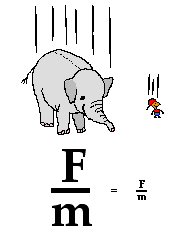
Newton's second law is a representation of the relationship between and objects mass and it's applied force and acceleration giving use the equation of Newton's second law F = ma. In Newton's second law the acceleration of an object depends directly upon the net forces acting upon the object. As the force acting upon an object is increased the acceleration of the object is also increased. As the mass of an object is increased, the acceleration of the object is decreased. So, Newton's second law is an applied force on an object that puts affect on an objects mass that directly effects the objects acceleration.
Newton's Third Law of Motion
Newton's third law of motion states, that for every action there is an equal and opposite reaction. This means for every force out there is a force the same magnitude that acts equal and opposite of the initial force.
Newton's First Law of Motion: An object at rest will remain at rest unless acted on by an unbalanced force. An object in motion continues in motion with the same speed and in the same direction unless acted upon by an unbalanced force. This law is often called "the law of inertia".
Static Equilibrium (Swing)
Dynamic Equilibrium (Swing)
Newton's Second Law of Motion: Acceleration is produced when a force acts on a mass. The greater the mass (of the object being accelerated) the greater the amount of force needed (to accelerate the object).The relationship between an object's mass m, its acceleration a, and the applied force F is F = ma.
3 Balls Freefall
Anthony Pushing Car
Carlos Pushing Car
Newton's Third Law of Motion: For every action there is an equal and opposite reaction.
Group:Parker, and Joshua
Video Link: http://youtu.be/nmtU1S0WQpM
First Law:
-An object in motion will must stay in motion unless an unbalanced force acts upon it
- An object at rest will stay at equilibrium
-Two types Static- not moving and Dyamic- constant motion or moving
Second Law:
-Force is directly related to acceleration whereas mass is an inverse of force
-The force can happen horizontal or vertically
-The more force the faster the acceleration and the more distance it travels
- F=ma
1st Law- An object at rest tends to stay at rest, while an object in motion tends to stay in motion
2nd Law- The acceleration of an object is dependent upon two variables - the net force acting upon the object and the mass of the object. The acceleration of an object depends directly upon the net force acting upon the object, and inversely upon the mass of the object. As the force acting upon an object is increased, the acceleration of the object is increased. As the mass of an object is increased, the acceleration of the object is decreased. In other words, F=ma.
3rd Law- For every action, there is an equal and opposite reaction.
If Newton's Third Law did not apply, then if we impacted a wall, we would be able to phase right through it, like the girl in this video clip:




.jpeg)
.jpeg)
.jpeg)
.jpeg)
.jpeg)
.jpeg)
.jpeg)

